Why a Workout at Home Works
A workout at home can be just as effective as training in a gym—often more so—because it removes the biggest barriers to consistency: travel time, crowds, and complicated setups. With a clear plan, a small amount of space, and a few basic tools (or none at all), you can build strength, improve cardiovascular fitness, and boost mobility using your own bodyweight.
The key is structure. Home workouts work when you train with intention: choose exercises that cover your whole body, progress over time, and keep sessions short enough to stick with. Whether your goal is fat loss, strength, energy, or stress relief, the best routine is the one you’ll repeat week after week.
What You Need to Start (Space, Equipment, and Mindset)
Space and setup
You don’t need a dedicated home gym. A clear area about the size of a yoga mat is enough for most routines. Make sure the floor is stable, you have decent ventilation, and you can safely step forward/backward without bumping furniture. If you’re doing jumping moves, consider a sturdier surface and be mindful of noise.
Helpful (but optional) equipment
- Exercise mat: Adds comfort for floor work and stretching.
- Resistance bands: Great for strength and mobility without heavy weights.
- Adjustable dumbbells or kettlebell: Useful for building strength progressively.
- Sturdy chair or bench: Supports step-ups, triceps dips, and incline push-ups.
- Timer app: Keeps intervals and rest consistent.
Mindset: consistency beats intensity
Many people go too hard on day one, then struggle to repeat it. Aim for workouts that feel challenging but doable, then gradually increase the difficulty. If you can only commit to 15–20 minutes, that’s enough—especially if you train 3–5 times per week.
Key Principles for Effective Home Workouts
Train movement patterns, not just muscles
A balanced workout at home should include these movement patterns:
- Squat: Builds legs and core (e.g., bodyweight squats).
- Hinge: Strengthens glutes/hamstrings (e.g., hip hinges, glute bridges).
- Push: Chest/shoulders/triceps (e.g., push-ups).
- Pull: Back/biceps (bands, rows, or towel rows where possible).
- Core carry/brace: Planks, dead bugs, slow controlled holds.
Progressive overload at home
You don’t need heavier weights every week to improve. Try these progression methods:
- Add reps (e.g., 8 to 10 to 12).
- Add sets (2 sets to 3 sets).
- Slow the tempo (3 seconds down, 1 second up).
- Increase range of motion (deeper squat, full push-up).
- Reduce rest time (60 seconds down to 30–45).
- Use harder variations (incline push-up to standard to decline).
Balance strength, cardio, and mobility
The most sustainable plan usually blends:
- Strength training 2–4 days/week
- Cardio 2–3 days/week (can be low-impact)
- Mobility or stretching 5–10 minutes most days
Sample Home Workout Plans (Beginner to Advanced)
Beginner: 20-minute full-body (no equipment)
Do 2–3 rounds. Rest 60–90 seconds between rounds. Move slowly and focus on form.
- Bodyweight squats: 10–12 reps
- Incline push-ups (hands on a counter or sturdy table): 8–10 reps
- Glute bridges: 12–15 reps
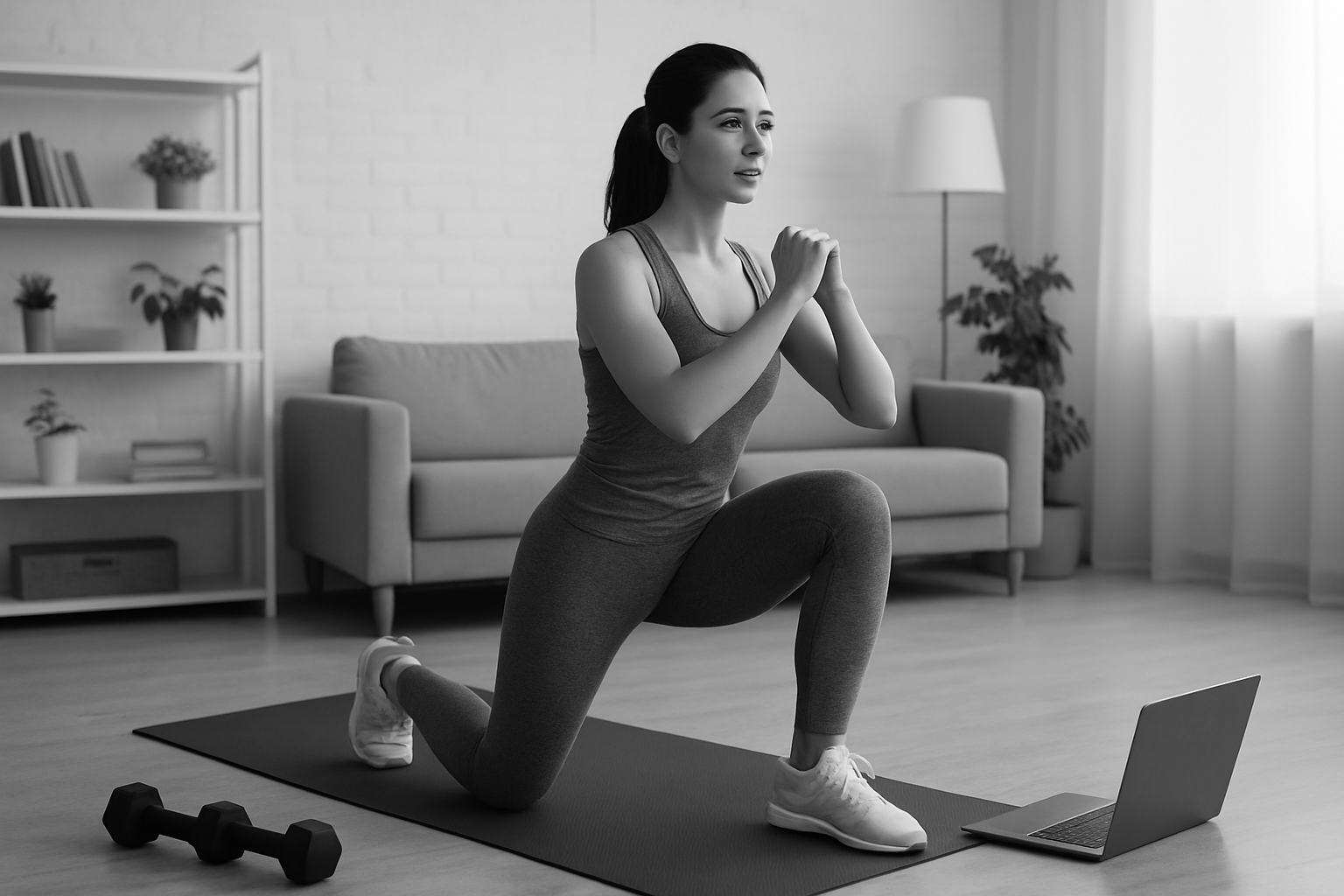
- Reverse lunges: 8 reps/side
- Plank: 20–30 seconds
Tip: If any move hurts (sharp pain), swap it for a gentler option or shorten the range of motion.
Intermediate: 30-minute strength + cardio blend
Complete the strength circuit for 3 rounds, then finish with a short cardio block.
Strength circuit (3 rounds):
- Squat to chair (or goblet squat if you have a weight): 10–15 reps
- Push-ups: 8–12 reps
- Single-leg Romanian deadlift (bodyweight or light weight): 8–10 reps/side
- Band row (or towel row with careful positioning): 12–15 reps
- Dead bug: 10 reps/side
Cardio finisher (6 minutes): 30 seconds work / 30 seconds rest
- High knees or marching in place
- Mountain climbers (slow if needed)
- Jumping jacks (or step jacks)
Advanced: 35–45-minute strength-focused session
This option is ideal if you have dumbbells, bands, or a kettlebell. Rest 60–90 seconds between sets.
- Goblet squat or front squat: 4 sets x 6–10 reps
- Romanian deadlift: 4 sets x 8–12 reps
- Overhead press: 3 sets x 6–10 reps
- One-arm row: 3 sets x 8–12 reps/side
- Core superset: plank (45–60 sec) + side plank (30–45 sec/side), 2 rounds
Optional finisher: 5 minutes of EMOM (every minute on the minute): 10 burpees or 15 kettlebell swings.
How to Stay Motivated and Consistent
Make it easy to start
Lay out your workout clothes the night before, keep a mat or bands visible, and choose a default workout time. Reducing friction makes follow-through much more likely—especially on busy days.
Track progress in simple ways
You don’t need a complex spreadsheet. Track one or two metrics:
- Reps completed with good form
- Plank time
- How many rounds you finished
- Rest time needed between sets
Small improvements add up quickly and keep motivation high.
Use the “minimum effective workout”
On low-energy days, do a short version: 10 minutes, one circuit, or even a brisk walk. Keeping the habit is more important than making every session perfect.
Safety Tips and Common Mistakes to Avoid
Warm up and cool down
Spend 3–5 minutes warming up (marching in place, arm circles, hip hinges, gentle squats). After your workout, do 3–5 minutes of easy stretching, focusing on hips, hamstrings, chest, and shoulders.
Prioritize form over speed
Rushing through reps often shifts work away from the target muscles and increases injury risk. Move with control, keep your core lightly braced, and stop each set when your form starts to break down.
Don’t ignore recovery
Home workouts are convenient, which can tempt you to train hard every day. Instead, alternate harder days with lighter days, get adequate sleep, and fuel your body with balanced meals—especially protein and hydration.
Conclusion
A workout at home is one of the most practical ways to build a consistent fitness routine. Start with a simple plan, focus on full-body movement patterns, and progress gradually by adding reps, sets, or more challenging variations. Keep it realistic, track small wins, and you’ll be surprised how quickly strength and energy improve—no gym required.