
Why exercise selection matters for muscle growth
If your goal is hypertrophy (building muscle size), the exercises you choose can make your training more effective and easier to progress over time. The best exercises for muscle growth typically share a few traits: they allow you to use challenging loads, train through a solid range of motion, repeat consistently with good form, and progressively overload (adding reps, weight, or sets over time).
That said, the “best” exercise is also the one you can perform safely and consistently. A great plan usually combines big compound lifts (to move heavier weight and stimulate lots of muscle) with targeted isolation work (to bring up specific areas and add quality volume).
Key principles behind hypertrophy training
Before diving into specific exercises, keep these fundamentals in mind. They’ll help you get more growth from whatever movements you choose.
Progressive overload
Muscle growth requires a reason for your body to adapt. Progressive overload means gradually increasing training demands—adding 5–10 pounds, squeezing out an extra rep, or increasing total weekly sets. Track your lifts and aim for small improvements weekly or biweekly.
Train close to failure (with good form)
You don’t need to max out every set, but you should regularly work near muscular failure to recruit high-threshold motor units. For many lifters, stopping with about 0–3 reps in reserve (RIR) on most working sets is a productive sweet spot—hard, but controlled.
Use enough volume and frequency
Most people grow well with roughly 10–20 challenging sets per muscle group per week, spread across 2–3 sessions. If progress stalls, you can adjust volume, exercise selection, or recovery (sleep, nutrition, stress).
Prioritize range of motion and tension
Full, controlled reps help you train the muscle through its working range and keep tension where you want it. Avoid bouncing or cutting reps short to chase heavier weight—especially on isolation movements.
Best compound exercises for muscle growth
Compound exercises train multiple joints and muscle groups at once. They’re ideal for building overall size and strength, and they’re typically the cornerstone of effective hypertrophy programs.
Barbell back squat
The back squat is a classic for developing the quads, glutes, and adductors, with significant core and upper-back involvement. It’s also highly scalable—great for both beginners and advanced lifters.
- Muscles targeted: Quads, glutes, adductors, core
- Hypertrophy tip: Use controlled depth and consistent technique; try 6–10 reps for strength-size overlap, or 8–12 for more pure hypertrophy
Romanian deadlift (RDL)
RDLs are one of the most effective posterior-chain builders, emphasizing the hamstrings and glutes through a deep hip hinge. Compared with conventional deadlifts, they often provide better hypertrophy stimulus with less overall fatigue.
- Muscles targeted: Hamstrings, glutes, lower back (isometric)
- Hypertrophy tip: Keep the bar close, feel a hamstring stretch, and avoid turning it into a squat
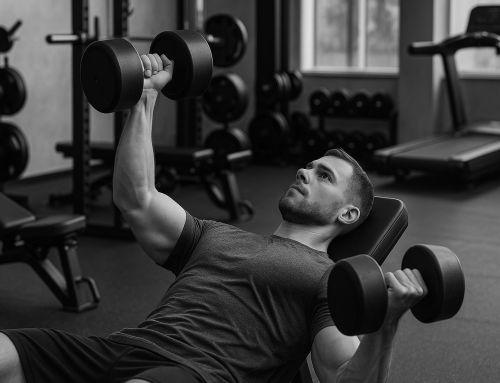
Bench press (barbell or dumbbell)
The bench press remains a top choice for building the chest, shoulders, and triceps. Dumbbells can offer a longer range of motion and help address left-to-right strength imbalances.
- Muscles targeted: Chest, triceps, front delts
- Hypertrophy tip: Use a slight pause on the chest or slow the lowering phase to maintain tension and consistency
Pull-ups or lat pulldowns
For a wider back and stronger upper body, vertical pulling is essential. Pull-ups are highly effective if you can do them with good form; lat pulldowns are a great alternative that’s easier to load and progress.
- Muscles targeted: Lats, upper back, biceps
- Hypertrophy tip: Think “elbows to ribs,” keep your torso steady, and use full reps without swinging
Barbell row or chest-supported row
Rows build thickness in the upper back and help balance pressing volume. Chest-supported rows reduce lower-back fatigue, making them a strong option if recovery is a concern.
- Muscles targeted: Mid-back, lats, rear delts, biceps
- Hypertrophy tip: Control the eccentric (lowering) and pause briefly at the top to avoid using momentum
Overhead press
The overhead press is a powerful shoulder builder and also challenges the upper back and core. If barbell pressing bothers your shoulders, dumbbells or a machine press can feel more joint-friendly.
- Muscles targeted: Shoulders (especially front/side delts), triceps
- Hypertrophy tip: Use a moderate rep range (6–12) and avoid over-arching your lower back
Best isolation exercises to maximize hypertrophy
Isolation exercises help you add targeted volume without the systemic fatigue of heavy compounds. They’re especially useful for bringing up lagging muscles and improving symmetry.
Leg extension
Leg extensions directly target the quads and are excellent for adding quad volume after squats or leg presses.
- Hypertrophy tip: Use controlled reps, squeeze at the top, and keep tension—don’t slam the stack
Leg curl (seated or lying)
Hamstrings respond well to direct knee-flexion work. Many lifters find seated leg curls especially effective because they train the hamstrings in a lengthened position.
- Hypertrophy tip: Prioritize full range and a slow lowering phase
Lat-focused cable pullover
Cable pullovers isolate the lats without biceps being the limiting factor, making them a great “finisher” for back days.
- Hypertrophy tip: Keep ribs down and focus on pulling with your lats, not your arms
Lateral raises (dumbbells or cables)
If you want broader shoulders, lateral raises are non-negotiable. Cables often keep more constant tension through the movement.
- Hypertrophy tip: Use lighter loads, higher reps (10–20), and minimal body swing
Triceps: cable pressdowns and overhead extensions
Triceps are a major contributor to arm size. Pressdowns hit the lateral head well, while overhead extensions emphasize the long head in a stretched position.
- Hypertrophy tip: Include at least one overhead triceps movement weekly for fuller development
Biceps: incline curls and cable curls
Incline curls train the biceps in a lengthened position, while cable curls provide consistent tension and easy progression with small weight jumps.
- Hypertrophy tip: Keep elbows stable and avoid turning curls into a full-body movement
How to program these exercises for the best results
You don’t need dozens of movements—just a smart mix that you can progress. Here are practical programming guidelines.
Choose 1–2 compounds per muscle group, then add isolation work
For example, a lower-body day might center on squats and RDLs, then add leg extensions and leg curls. An upper-body day might include bench and rows, then add lateral raises and arm work.
Use effective rep ranges
- Compounds: often thrive in the 5–10 or 6–12 rep range
- Isolation: commonly works best in the 10–20 range (sometimes 15–30, depending on the movement)
Progress with a simple double-progression method
Pick a rep range (say 8–12). When you can hit 12 reps on all sets with good form, increase weight slightly and repeat. This keeps progress steady without guessing.
Recover like it matters
Muscle is built outside the gym. Aim for sufficient protein, consistent calories (a small surplus helps), and 7–9 hours of sleep. If your performance drops or joints ache, reduce volume briefly and rebuild.
Conclusion
The best exercises for muscle growth are the ones that let you train hard, progress consistently, and accumulate enough high-quality volume. Build your foundation with compounds like squats, RDLs, presses, and rows, then use isolation moves to target weaker areas and add growth-focused volume. Stick to a small set of proven lifts, track your progress, and you’ll be set up for long-term muscle gains.